
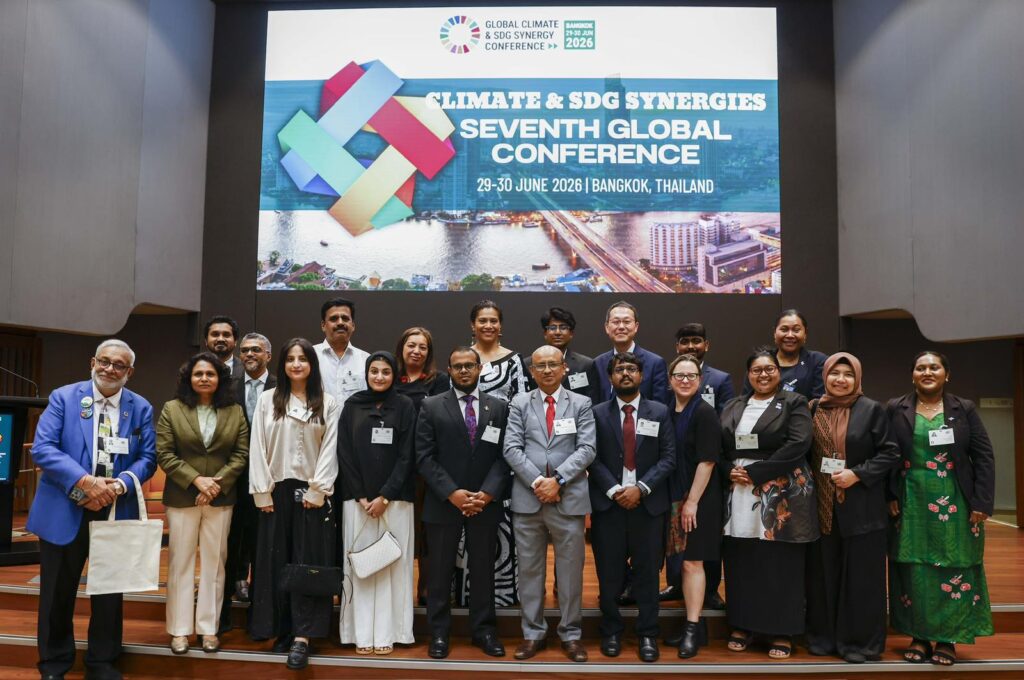
Bangkok, Thailand – Pacific Small Island Developing States (PSIDS) Chair and Minister for Information, Environment and Climate Change, Hon. Lynda Tabuya, has called on the international community to recognise Indigenous knowledge as an essential part of global climate solutions, while urging greater climate justice and energy resilience for Small Island Developing States (SIDS).
Speaking at the ‘Ministerial Roundtable on Climate Justice, Energy Resilience and SIDS: Delivering Integrated Solutions Where Vulnerability is Greatest’ at the United Nations Conference Centre in Bangkok, Hon. Tabuya said Pacific communities have lived sustainably with nature for generations, and their traditional knowledge must stand alongside science in shaping climate action.
“Indigenous Peoples are not just stakeholders. We are rights holders. Our knowledge systems have sustained our people and our environment for centuries and must be recognised as part of the solution,” she said.
Hon. Tabuya also called on the international community to match climate ambition with greater climate finance, fair partnerships and practical solutions that strengthen energy resilience.
Drawing on Fiji’s recent fuel crisis, she shared her personal experience as someone from the maritime province of Kadavu, where cancelled shipping services left island communities stranded. Without diesel, fish and crops could not be stored or transported to markets, directly impacting livelihoods, food security and local economies.
“This is the reality of our dependence on fossil fuels. For maritime communities, energy resilience is not just about climate action, it is about survival and economic security,” she said.
She highlighted the Fiji Rural Electrification Fund, which is delivering solar mini-grid systems to remote maritime communities.
The Minister also reiterated Fiji’s support for accelerating the global transition away from fossil fuels while ensuring a just transition through technology transfer, capacity building and international cooperation.
She called for reforms to the international financial system to improve access to concessional climate finance, strengthen support for adaptation and loss and damage, and keep the 1.5°C goal within reach.
“Fiji will continue to lead, to advocate and to act. We call on all countries to do the same,” she said.
The Minister joined ministers from fellow Small Island Developing States, including the Maldives, alongside senior United Nations officials and development partners to discuss integrated solutions that strengthen climate resilience, energy security and sustainable development.