The Ministry of Environment and Climate Change continues to progress Fiji’s biodiversity agenda, following Cabinet’s approval of the Fiji National Biodiversity Strategy and Action Plan 2026–2030, the National Invasive Species Framework and Strategic Action Plan, and the National Access to Genetic Resources and Benefit Sharing Policy.
Together, the three policies establish Fiji’s coordinated national framework for biodiversity management, covering protection, sustainable use, and benefit-sharing.
Experts and conservation partners commended this milestone, recognizing it as the culmination of years of technical work and consultation across Government and stakeholders, and a clear shift towards coordinated implementation.
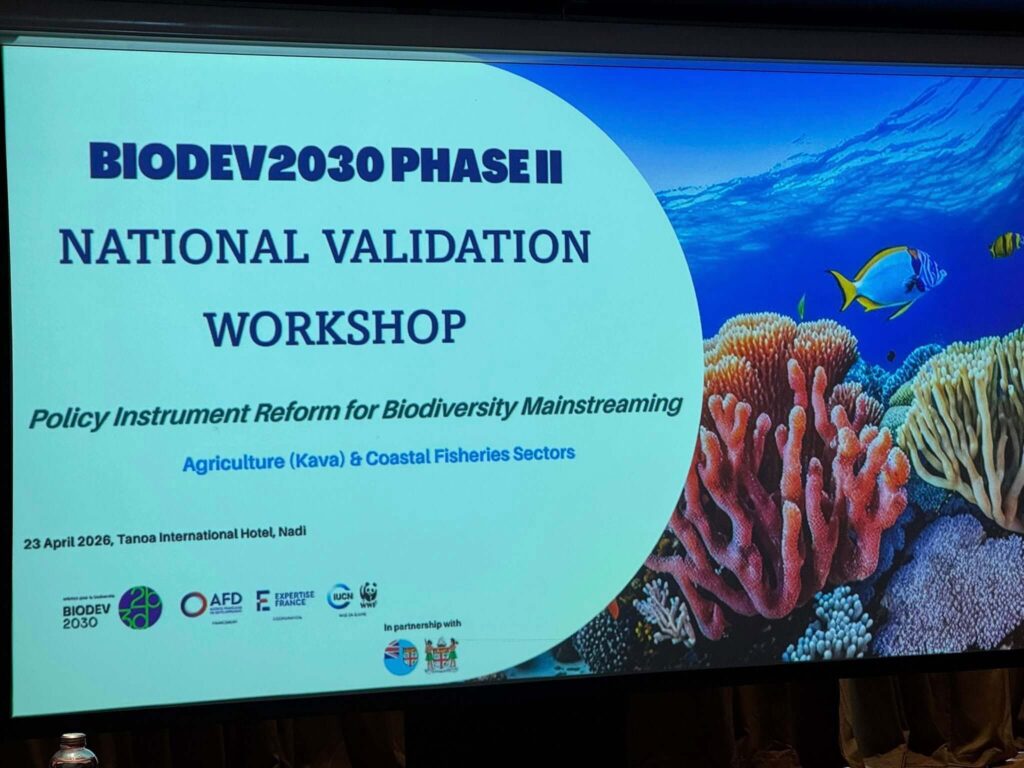
Speaking at the BIODEV2030 Phase II National Validation Workshop in Nadi yesterday, Permanent Secretary for Environment and Climate Change Dr Sivendra Michael said biodiversity must be understood beyond its environmental dimension.
“Biodiversity conservation cannot be treated as a stand-alone environmental concern. In Fiji, it is also a livelihood concern, a development concern and a governance concern,” he said.
He said the Ministry’s focus is now firmly on implementation, with initiatives such as BIODEV2030 supporting the translation of policy into practical outcomes.
The BIODEV2030 project, led by the International Union for Conservation of Nature and supported by the Agence Française de Développement, works to integrate biodiversity considerations into key economic sectors.
In Fiji, the programme has prioritized coastal fisheries and the kava sector, reflecting their importance to livelihoods, food security, and cultural identity.
Dr Michael said the workshop is designed to move discussions towards decisions.
“We are here to develop the way forward. Let us leave with decisions, clear roles, and a pathway forward,” he said.
Participants reviewed national policy synthesis reports, policy briefs, and draft Cabinet papers, with the aim of finalizing recommendations, confirming responsibilities, and agreeing on timelines for implementation.
The workshop brought together representatives from Government, statutory bodies, financial institutions, and civil society, including BirdLife International, Wildlife Conservation Society, National Trust of Fiji, NatureFiji-MareqetiViti, and WWF Pacific.
BIODEV2030 Project Manager Vinay Singh said biodiversity loss carries direct consequences.
“If biodiversity is degraded, the costs are not abstract; they are felt in the resilience of our communities, the sustainability of our productive sectors, and the opportunities available to future generations,” he said.
The BIODEV2030 initiative, launched in 2020, supports countries to reduce biodiversity loss while strengthening economic resilience.
In Fiji, officials say its outputs will directly support the implementation of newly endorsed national policies, embedding biodiversity considerations across development planning and key sectors of the economy.