
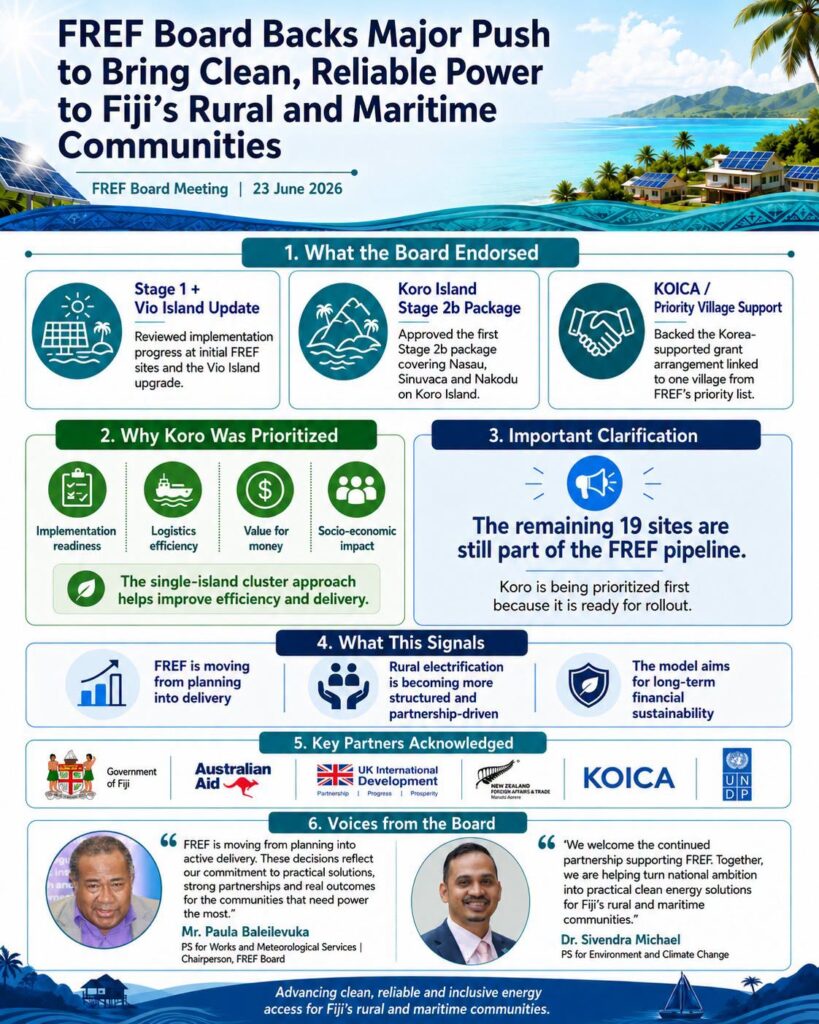
Fiji’s rural electrification agenda took a major step forward this week, with the Fiji Rural Electrification Fund Board of Trustees endorsing a series of decisions that will accelerate the delivery of clean, reliable and affordable renewable energy to rural and maritime communities.
At its meeting on Tuesday, 23 June 2026, the FREF Board approved all recommendations across three key Board Papers covering implementation progress under Stage 1, the Vio Island Stage 2a Solar Mini-Grid Upgrade, the selection of Koro Island as the Stage 2b implementation package, and the approval of a Korea-supported grant arrangement to finance the next FREF project site.
The decisions signal FREF’s continued shift from planning and feasibility work into full-scale delivery, with works now progressing across Kioa, Yacata, Lakeba, Vio and Koro, and a new Korea-supported project preparing to move into procurement.
Stage 1: Solar mini-grid works advancing across Salia, Yacata and Yadrana
The Board noted strong implementation progress across the first three FREF solar mini-grid sites: Salia Village on Kioa Island (funded by the Government of New Zealand), Yacata Village on Yacata Island (funded by the Government of Australia), and Yadrana Village on Lakeba Island (jointly funded by the Governments of New Zealand and United Kingdom).
The Stage 1 works, valued at approximately USD 3 million, were awarded through a competitive procurement process to CBS Power Solutions for Salia and Yacata, and CDGA Engineering Consultants Ltd for Yadrana.
Site mobilisation has now been completed across all three communities. House wiring is also well advanced, with approximately 95 percent completed on Kioa Island, 90 percent completed on Yacata Island, and 90 percent completed in Yadrana Village.
Major solar mini-grid components have already been procured, including solar panels, batteries, battery racks, AC inverters, battery inverters, multi-cluster boxes, feeder pillars and meter boxes. Additional materials, including solar mounting structures, streetlights, electrical reticulation materials and smart meters, are currently en route to Fiji.
The Board was also informed that logistics arrangements have progressed, with contractors coordinating the movement of approximately 200 tonnes of materials and equipment to project sites.
Subject to the timely delivery of remaining materials, successful transportation to site and continued contractor performance, the Stage 1 works are expected to be completed by the end of October 2026.
Vio Island Stage 2a: Strengthening Fiji’s first FREF pilot site
The Board also noted that the competitive tender and contracting process for the Vio Island Solar Mini-Grid Upgrade, known as Stage 2a, has been completed.
The Vio Island upgrade, valued at USD 319,031, will increase the capacity, reliability and resilience of the existing Vio Island solar mini-grid system. The works are expected to be completed by December 2026.
The upgrade will add 25 kWp of new solar PV capacity, bringing the total system capacity to approximately 30.88 kW. This will improve electricity reliability for 48 households, the newly completed evacuation centre, and community-based productive uses such as cold storage, digital connectivity and small-scale food processing.
The project is fully financed by the Government of Australia through the FREF Trust Fund and is being implemented by UNDP in partnership with the Department of Energy and the FREF Technical Team.
A key feature of the upgrade is the use of the newly constructed Category 5 cyclone-certified evacuation centre on Vio Island for roof-mounted solar panels. This will maximise available space for solar generation while also ensuring that the evacuation centre has a reliable power supply during emergencies.
This makes the Vio upgrade more than an energy project. It is also a resilience investment that will support everyday electricity needs, strengthen disaster preparedness and reduce reliance on diesel generation.
Koro Island selected for Stage 2b rollout
The Board endorsed the selection of Nasau, Sinuvaca and Nakodu on Koro Island as the Stage 2b implementation package under FREF.
The decision reflects a practical, evidence-based approach to scaling rural renewable energy delivery. Koro Island was selected because it offers the strongest combination of value for money, implementation readiness, logistics efficiency and socio-economic impact.
FREF has a long-term objective to electrify 399 rural and maritime communities across Fiji. To date, 75 sites have undergone pre-feasibility assessments, while 22 sites have advanced to detailed feasibility studies, socio-economic baselining, geotechnical assessments and tender design.
The 22-site prioritisation analysis confirmed that the Koro Island cluster has the lowest average cost per connection among the assessed clusters, at approximately USD 18,036 per connection. This is significantly lower than the average cost per connection for other assessed clusters in Lau, Kadavu, Gau and Batiki.
The Board noted that selecting three villages on one island allows FREF to aggregate logistics, labour, supervision, equipment movement, accommodation and operations and maintenance planning. This single-island approach is expected to reduce overhead costs and implementation risks compared with a dispersed multi-island rollout.
The Koro sites also benefit from road access, existing reticulation conditions and proximity to communities. This reduces the need for extensive land works, trenching and distribution infrastructure, making the package more cost-effective and implementation-ready.
The Stage 2b Koro package is expected to support 256 households and more than 10 public buildings across the three villages, providing access to clean, affordable and reliable solar electricity paired with digital connectivity solutions.
The Board further noted the strong socio-economic potential of the Koro sites, including opportunities for agriculture value addition, agri-processing, cold storage, small businesses, digital access and improved community services.
Importantly, the remaining 19 sites in the detailed FREF pipeline are not being removed. They will remain part of the implementation-ready pipeline and will be progressed in subsequent stages as additional donor financing is mobilised.
Korea-supported grant arrangement approved
The Board also endorsed support from the Government of the Republic of Korea, through the Korea International Cooperation Agency, to finance the electrification of one FREF site.
The Board approved the signing of the Grant Agreement between the Government of Fiji and Korea International Cooperation Agency to formalise this support.
The site to be electrified will be announced publicly at a later date. It has already undergone detailed socio-economic and technical baselining by UNDP and is ready to proceed to tender once funding is received.
This new support further strengthens FREF’s role as a trusted platform for partners seeking to invest in rural renewable energy through a transparent, technically sound and implementation-ready mechanism.
From plans to power: FREF moves into delivery
The decisions taken by the FREF Board mark a major milestone in Fiji’s clean energy transition.
Through Stage 1, the Vio Island upgrade, the Koro Island Stage 2b package and the Korea-supported project site, FREF is showing how rural electrification can be delivered in a structured, scalable and financially disciplined way.
The model brings together donor financing, Government oversight, technical due diligence, competitive procurement, socio-economic baselining, value-for-money assessments and long-term implementation planning.
It also links electricity access with wider development outcomes, including productive use, community resilience, public services, digital connectivity and reduced dependence on diesel-based energy systems.
Speaking on the Board’s decisions, Mr. Paula Baleilevuka, Permanent Secretary for Public Works and Meteorological Services and Chairperson of the FREF Board, said:
“The Board’s decisions represent a significant step forward for Fiji’s rural electrification agenda. FREF is moving from planning into active delivery, with communities across Kioa, Yacata, Lakeba, Vio and Koro now part of a growing pipeline of clean, reliable and sustainable rural energy investments. These decisions also show that Fiji is building a practical model for rural renewable energy delivery that can attract partner support, manage implementation risks and deliver real benefits for communities.”
Dr. Sivendra Michael, Permanent Secretary for Environment and Climate Change, added:
“On behalf of the Government of Fiji, I would like to express our sincere gratitude to UNDP for its continued support to the Fiji Rural Electrification Fund as the Lead Implementation Agency and Fund Advisor. UNDP’s strong project management support structures have been instrumental in accelerating implementation across our renewable energy investments. We also extend our appreciation to the Governments of Australia, New Zealand, the United Kingdom and the Republic of Korea for channelling critical climate finance through FREF. Their support is helping to unlock the development potential of our rural and maritime communities, driving economic opportunity while strengthening climate resilience across Fiji.”
The FREF Board reaffirmed the importance of continued implementation oversight by UNDP, the Department of Energy, the FREF Technical Team and the FREF Unit to ensure that approved projects are delivered on time, with value for money, and in line with technical, safety and community requirements.
About the Fiji Rural Electrification Fund
The Fiji Rural Electrification Fund is a financing and delivery mechanism established to support clean, reliable and sustainable electrification for rural and maritime communities in Fiji. FREF seeks to move rural electrification away from ad hoc interventions towards a structured, partnership-driven and financially sustainable model that can mobilise donor support, prepare bankable projects, and deliver renewable energy solutions for communities not connected to the national grid.
ENDS