
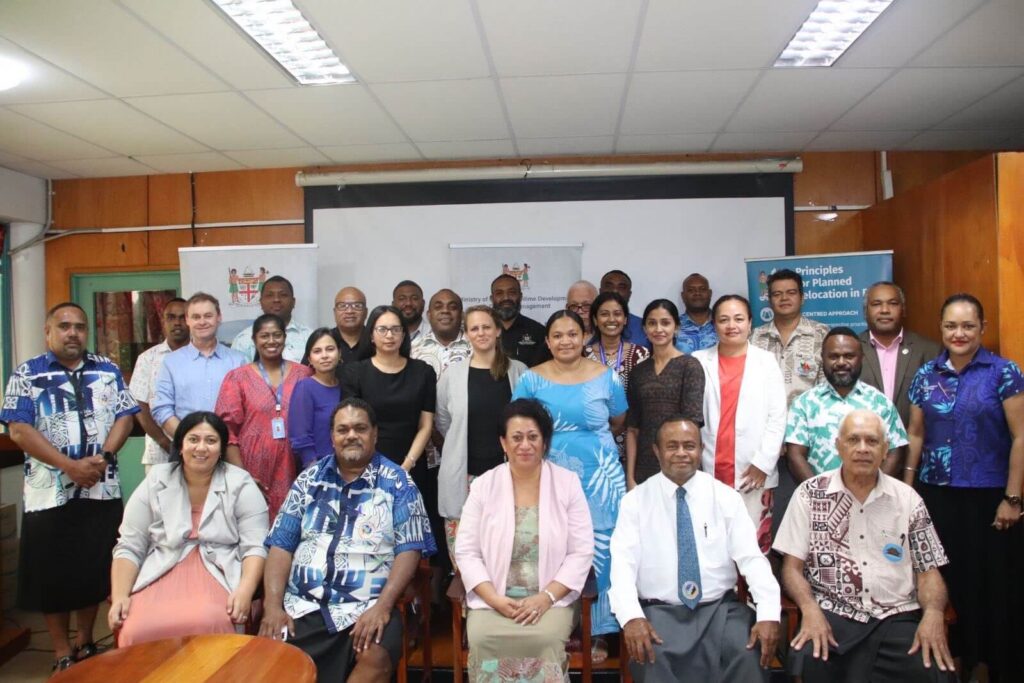
The Ministry of Environment and Climate Change convened the 3rd Quarterly Meeting of the Fijian Taskforce on the Relocation and Displacement of Communities Vulnerable to the Impacts of Climate Change for the 2025–2026 financial year on 23 April 2026 at the Commissioner Northern Office in Labasa.
The meeting brought together Divisional Commissioners, key government representatives, development partners, and technical experts to assess progress and strengthen coordination on Fiji’s climate-induced relocation initiatives.
Permanent Secretary for Environment and Climate Change, Dr Sivendra Michael, addressed members virtually, outlined key considerations for demonstrating progress and setting clear priorities for the Taskforce moving forward.
The Taskforce operates under Part 12 of the Climate Change Act 2021, which defines its governance framework and scope of work through a legislated Terms of Reference.
The meeting was chaired by Director Climate Change, Ms Senivasa Waqairamasi, who guided discussions toward clear resolutions and outcomes. She also acknowledged the ongoing support of the Deutsche Gesellschaft für Internationale Zusammenarbeit (GIZ), which serves as Secretariat to the Taskforce.
Key discussions focused on three main agenda items, including a proposed review of the Taskforce’s Terms of Reference to strengthen its mandate and operational effectiveness.
Members also deliberated on standard house design and planning, alongside updates from recent Technical Working Group engagements. An information paper highlighted ongoing collaborative efforts to advance relocation and resilience planning for vulnerable communities.
Representatives from the International Organization for Migration (IOM) provided updates on the Partnership for Climate Mobility Project, community training modules, and the Climate Catalytic Fund. A research presentation by Monash University explored community preferences for in-place adaptation versus relocation.
The Taskforce also received updates on media training initiatives from consultant Mr Netani Rika, as well as a presentation on the final draft Culture Checklist and Guiding Framework by Mr Simione Sevudredre, which was discussed for endorsement.
Discussions were further informed by a field visit conducted on 22 April 2026 to relocation sites in Nabavatu and Cogea in the Northern Division. The visit provided members with firsthand insight into ongoing relocation efforts and implementation challenges.
Observations from the site visits contributed to discussions on livelihood support, lessons for future standard operating procedures, cultural considerations, and the need for strengthened community engagement in relocation planning.
The meeting concluded with acknowledgements and a reaffirmation of the Taskforce’s commitment to advancing climate relocation efforts in Fiji.