
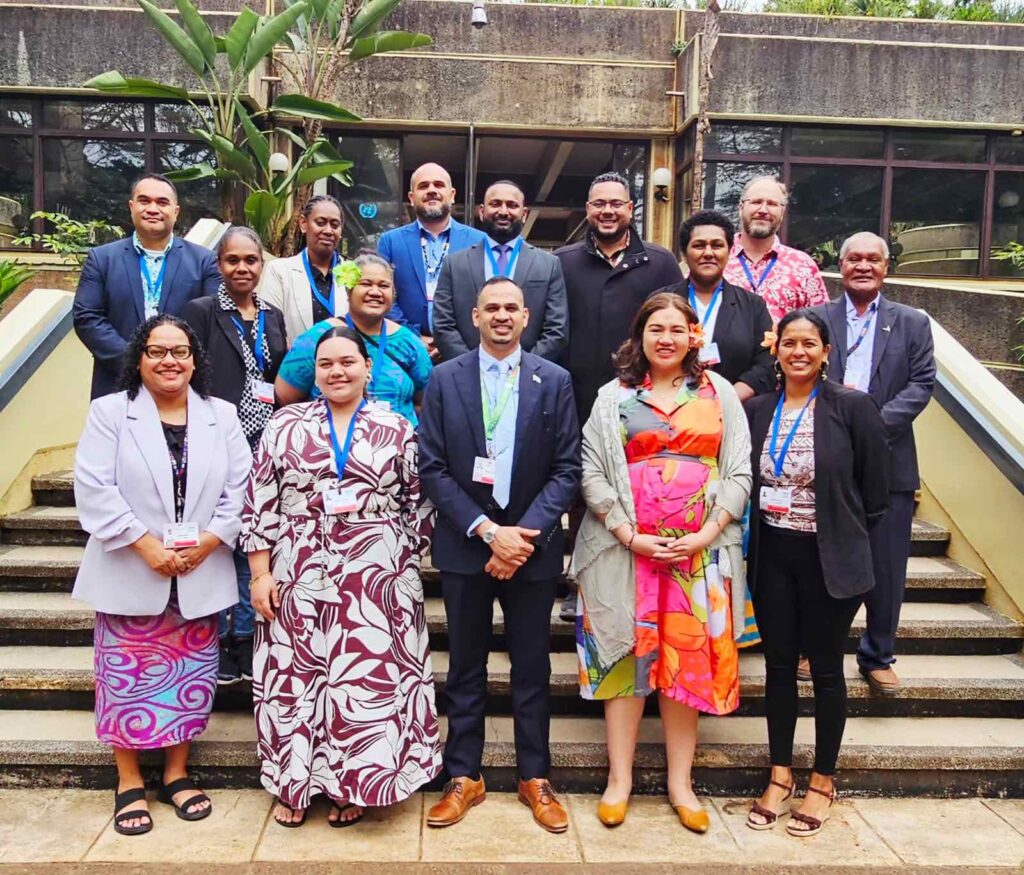
Last week, more than 190 governments met in Nairobi, Kenya, to continue negotiations on a new legally binding global treaty to end plastic pollution, including in the marine environment.
The Informal In-Person Meeting of Heads of Delegation to the Intergovernmental Negotiating Committee on Plastic Pollution was held from 30 June to 3 July 2026. These negotiations are taking place under United Nations Environment Assembly Resolution 5/14, adopted in 2022, which called for the development of an international legally binding instrument to address plastic pollution across its full life cycle, from production and design to use and disposal.
Fiji’s Permanent Secretary for Environment and Climate Change, Dr. Sivendra Michael, was selected to serve as one of the co-facilitators alongside Ms Elife Moore from Austria for discussions on “Means of Implementation”. This part of the treaty is central to how countries will be supported to put the agreement into practice.
The discussions under this cluster focused on finance, capacity-building, technical assistance, technology transfer and international cooperation. These issues are critical for developing countries and Small Island Developing States, including those in the Pacific, where plastic pollution directly affects oceans, coastal communities, food security, biodiversity and livelihoods.
Dr Michael said the role of the co-facilitators was to help countries have a constructive and focused discussion on what will be needed to implement the future treaty.
“As co-facilitator, my role has been to help guide discussions on how the future plastics treaty can be supported by implementation arrangements that are predictable, adequate, accessible and responsive to country needs,” Dr Michael said.
“The treaty must not only set ambition. It must also provide the means for countries to deliver. For developing countries and Small Island Developing States, implementation support will be central to whether this agreement succeeds.”
Dr Michael said a strong treaty must also be a fair and implementable treaty. Countries must have the support needed to turn commitments into practical action.”
The Nairobi meeting was part of continuing informal work to help countries narrow differences and identify areas of common ground ahead of the next stage of negotiations.
Dr Michael is expected to continue serving as co-facilitator during the next informal meeting scheduled for September 2026, as countries work towards finalizing the global plastics treaty.
Fiji’s role in the process reflects the importance of ensuring Pacific voices are part of shaping global solutions to plastic pollution, particularly on issues of fairness, accessibility and implementation support for vulnerable countries.