“The challenge is not to remove plastics altogether, but to retain what is valuable while changing what is unsustainable. That means preventing unnecessary waste, taking action further upstream and enabling circular solutions that are practical for Fiji.”
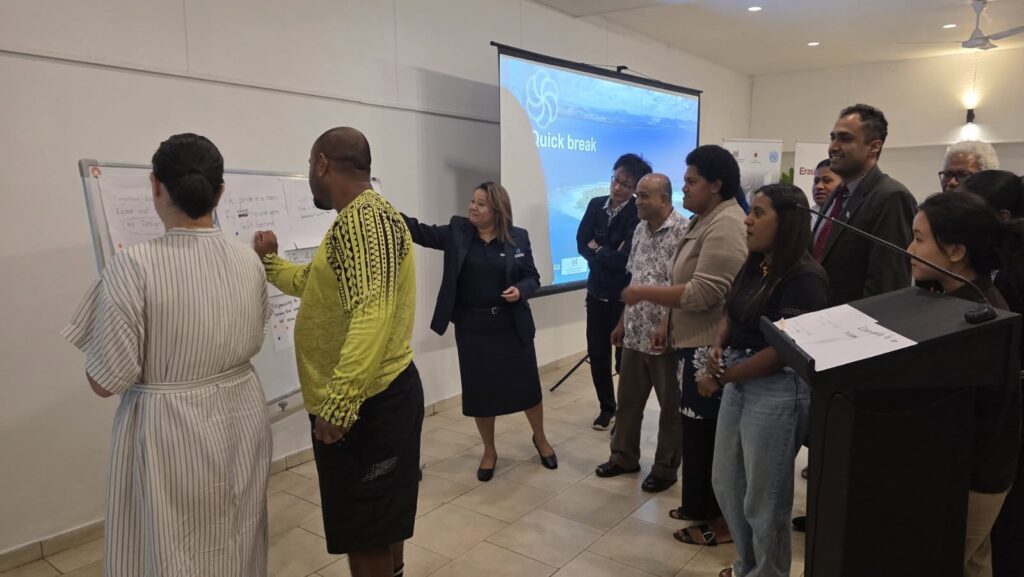
This was the message from Permanent Secretary for Environment and Climate Change, Dr Sivendra Michael, as he welcomed stakeholders to the Fiji Plastics Transition Roadmap Co-Design Workshop in Lami today (18.08.26).
The workshop brought together representatives from Government ministries, the private sector, academia, civil society and development partners to help shape Fiji’s long-term direction for managing plastics more sustainably and transitioning towards a more circular plastics economy.
Discussions focused on developing a shared vision for 2040, agreeing on principles to guide the transition, and exploring strategic pathways that will guide the development of Fiji’s Plastics Transition Roadmap and Action Plan. A key focus is on moving further upstream, preventing unnecessary plastic waste before it is generated, reducing reliance on problematic and avoidable plastics, and creating the conditions for reuse, better product design, resource recovery and other circular economy approaches.
The initiative is being implemented by the Ministry of Environment and Climate Change with support from the UNIDO – United Nations Industrial Development Organization, and funding support from Japan – The Government of Japan. It aims to strengthen Fiji’s policy and institutional framework, build institutional capacity and support businesses to adopt circular economy and resource-efficiency practices.
The Roadmap will help guide practical actions to prevent and reduce plastic waste at source, strengthen management across the full plastics lifecycle, and enable a shift away from linear “take-make-dispose” models towards reuse, circularity and more resource-efficient systems, while considering the needs of businesses, communities, consumers and Fiji’s economy.
Dr Michael said Fiji’s challenge is not simply to remove plastics altogether, but to distinguish between where plastics continue to provide important benefits and where current patterns of production, design, consumption and disposal are unsustainable.
The transition must therefore be deliberate and practical, balancing environmental protection with the realities faced by businesses, communities and consumers in a small island developing state.
“We want a Roadmap that gives us a shared direction, helps us make better and more coordinated decisions, and provides a foundation for practical action,” Dr Michael said.
The Ministry acknowledges the continued contribution of all partners and stakeholders working together to develop solutions that are practical, inclusive and suited to Fiji’s circumstances. The co-design process will continue Thursday, 20 August, with the Fiji Plastics Transition Action Plan Co-Design Workshop, where stakeholders will build on the strategic direction developed today to identify priority actions, responsibilities, partnerships and enabling measures needed to put the Roadmap into practice.
The Ministry emphasized that the transition will require action across the entire plastics value chain and cannot be delivered by Government alone. Businesses, communities, researchers, civil society and development partners will all have an important role in shaping and implementing solutions that work for Fiji.