
Clean-ups and enforcement alone cannot solve Fiji’s waste problem; greater responsibility must be taken for the products and packaging entering our communities and environment.
This was the message as Permanent Secretary for Environment and Climate Change, Dr Sivendra Michael, opened the National Consultation on Fiji’s National Product Stewardship Scheme and Beverage Container Regulations (19.08.26).
The consultation brings together Government, businesses, waste and recycling operators, academia, civil society, private sector organizations and development partners to help shape a practical system that can enhance resource efficiency and reducing waste entering the environment.
The proposed Container Deposit Scheme would give eligible beverage containers a value after use.
Consumers would pay a deposit when purchasing a beverage and receive the applicable refund when the empty eligible container is returned through the scheme.
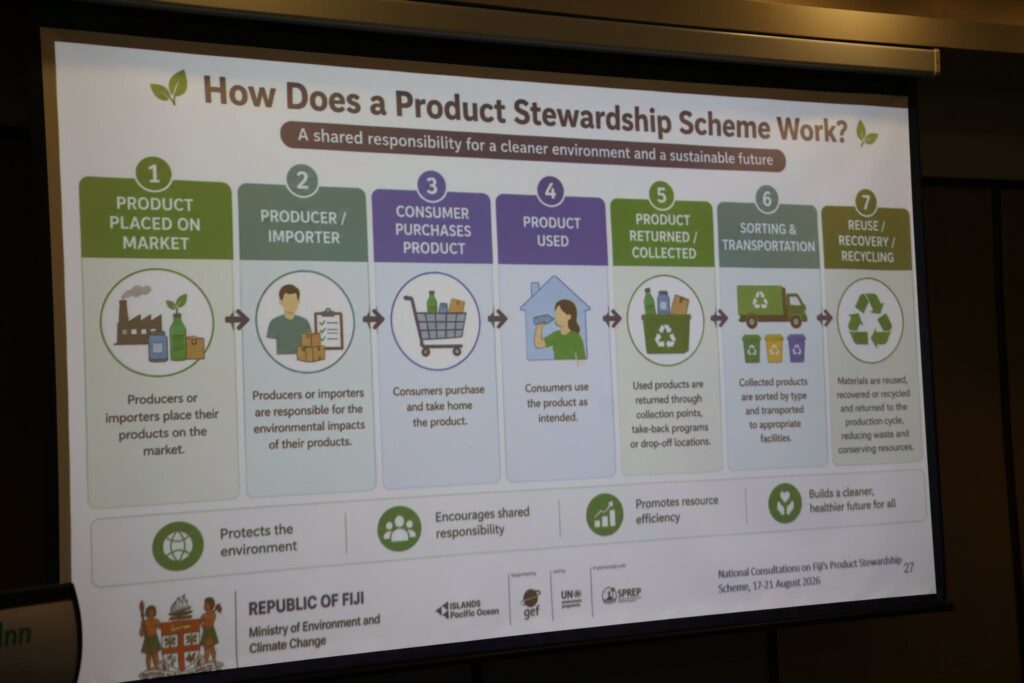
For producers, importers and retailers, the proposed Product Stewardship Scheme reinforces an important principle: responsibility for a product does not end when it is sold.
Responsibility must be shared throughout its lifecycle, from those placing products on the market to consumers, collection operators and recyclers.
Dr Michael reminded participants that the consultation is not a formality, urging them to identify what will work, what may not work and any unintended consequences before implementation.
The proposed scheme is part of a broader reform of Fiji’s waste management system.
Earlier this year, Parliament enacted the Litter (Amendment) Act 2026, strengthening litter control and increasing the fixed penalty for littering from $40 to $200.
Cabinet has also approved the revised Litter Regulations, with the new framework intended to come into effect from 1 September 2026.
Cabinet has further approved the National Waste Management and Pollution Control Strategy 2026–2035, providing Fiji with a ten-year national framework to strengthen and better coordinate waste management and pollution control across the full life cycle.
Together, these reforms signal a shift towards enhanced circularity, stronger enforcement, and shared responsibility for waste.
The Ministry’s goal is to establish systems that people understand, businesses can comply with, Government can effectively regulate and communities across Fiji can participate in.