
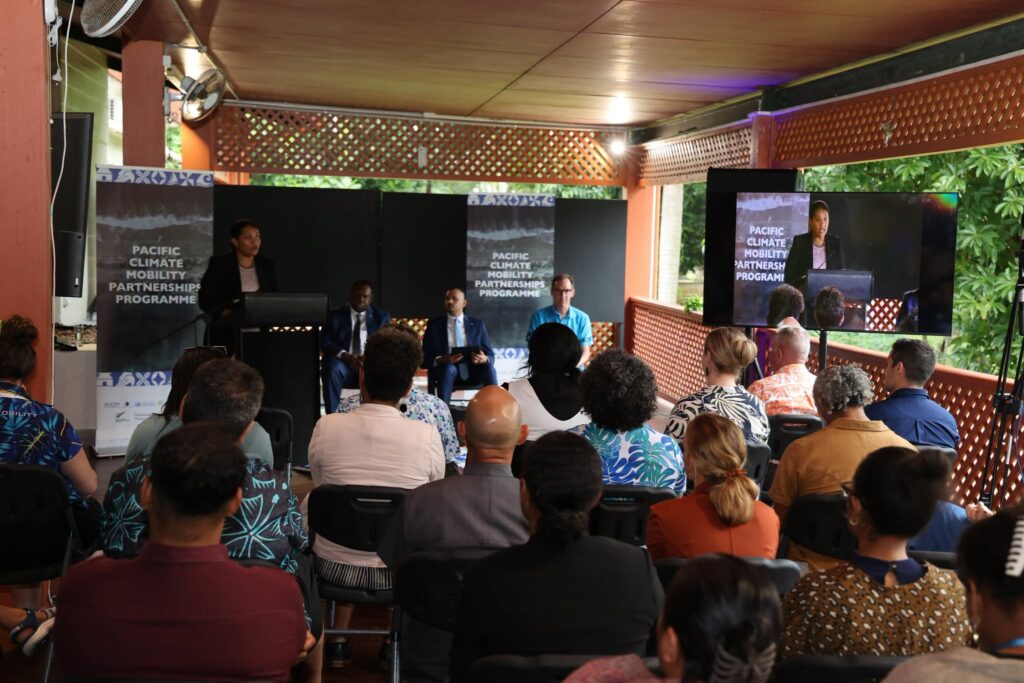
A new four-year regional programme aimed at strengthening how Pacific countries respond to climate-related displacement, planned relocation and other forms of climate mobility was launched in Suva today (25.08.26).
Permanent Secretary for Environment and Climate Change, Dr Sivendra Michael, delivered the keynote address at the Regional Launch of the Pacific Climate Mobility Partnerships Programme (PCMP) at the Fiji Museum, welcoming the initiative as an important step in ensuring Pacific people remain at the heart of decisions about their homes, communities and future in the face of increasing climate impacts.
Implemented by the International Organization for Migration (IOM), the Programme is funded by the Government of New Zealand with an investment of NZD 17.9 million over four years.
The Programme will assist Fiji in strengthening national coordination and supporting approaches to climate mobility that place community participation, consent, dignity and human rights at the centre of decisions affecting people whose homes and livelihoods are increasingly exposed to climate impacts.
Dr Michael said Fiji’s experiences with communities such as Vunidogoloa Village in Vanua Levu and Narikoso Village on Ono Island, Kadavu, demonstrated that planned relocation is much more than physically moving people from one location to another.
“We have relocated, and continue to relocate, communities through a planned, community-led, rights-based process, and we have learned, often the hard way, that relocation done well takes time, evidence and, above all, trust,” Dr Michael said.
The Programme builds on two earlier phases of the Pacific Climate Change Migration and Human Security Programme, which helped strengthen regional policy foundations, data and evidence systems, coordination and knowledge-sharing between Pacific countries.
For Fiji, this means strengthening the systems and partnerships needed to support communities facing difficult decisions because of sea-level rise and other climate impacts, while recognising that leaving a home, ancestral land and familiar way of life is never a simple decision.
Dr Michael stressed that Government cannot undertake this complex and costly work alone, calling on regional organisations, development partners, civil society, academia and the private sector to contribute technical expertise, financing, data and innovation.
The Government of Fiji, through the Ministry of Environment and Climate Change, acknowledges all programme partners for supporting Pacific-led climate mobility action. Fiji remains committed to ensuring decisions are made with communities, not simply for them, respecting their voices, cultural connections and aspirations while building safer, more resilient futures.