
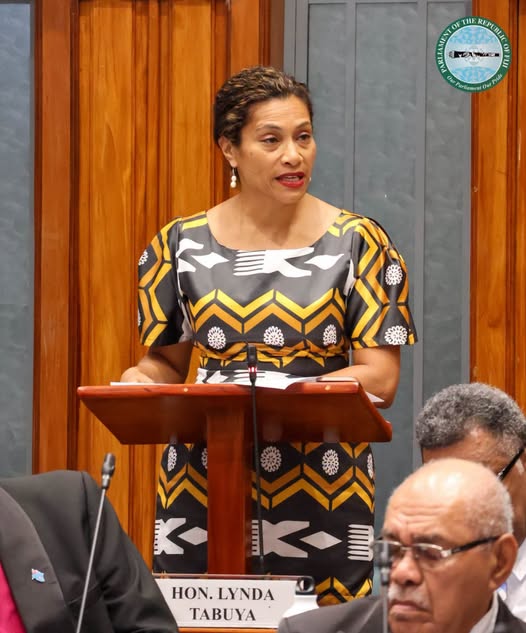
MINISTERIAL STATEMENT
Honourable Speaker,
Honourable Prime Minister,
Honourable Deputy Prime Minister,
Honourable Leader of the Opposition,
Honourable Members of Parliament,
Ladies and gentlemen,
I rise today to update this House on two Conferences of the Parties that matter greatly to Fiji: the UN Biodiversity Conference, CBD COP17, which was held in Yerevan, Armenia, from 19 to 31 October, and the upcoming UN Climate Change Conference, COP31, which commences in Antalya, Türkiye, on 9 November.
Mr Speaker, Sir, let me begin with what this is about, because the language of these meetings can hide what is at stake. “Biodiversity” is simply the word for the living things our people depend on every day: the fish and the reef in our i qoliqoli, the mangroves that hold our coastline together, the forests that protect our water catchments, the plants our grandmothers used as medicine. When a reef dies, the fish go, and with them the food and income of a coastal village. When mangroves are cleared, the sea comes further inland with the next cyclone. For an island nation, nature is not something to protect after development. It is the foundation development stands on.
The Convention on Biological Diversity is the treaty that sets the rules for how the world protects that foundation. It was opened for signature at the Earth Summit in Rio de Janeiro in 1992, alongside the climate change Convention, and almost every country in the world is a Party to it. Its governing body, the Conference of the Parties, or “COP”, meets every two years. In 2022, at COP15 in Montreal, the world adopted the Kunming-Montreal Global Biodiversity Framework: 23 targets to be met by 2030, the best known being to protect at least 30 per cent of the world’s land and sea, often called the “30 by 30” target. COP17 was the first time the world sat down, formally and together, to check whether it is on track.
Mr Speaker, Sir, the answer was sobering. The world is off track on 22 of the 23 targets. Fewer than half of all countries submitted their national biodiversity plans on time. On current plans, the world will protect about 26 per cent of its land and only about 12 per cent of its ocean by 2030. The commitment that developed countries would provide at least US$20 billion a year in international biodiversity finance by 2025 was not met. And, as Fiji told Ministers in Yerevan, money that harms nature still outpaces money that protects it by about thirty to one.
Mr. Speaker Sir,
Fiji did not go to Yerevan for itself alone. Fiji chairs the Pacific Small Island Developing States, and when Fiji speaks in these rooms, it speaks for all 14 Pacific island Parties. Our message never changed: the Pacific did not come to renegotiate its ambition; it came to secure the means to deliver it. Ambition without finance, technology and the capacity to use them is a promise on paper.
Every decision at a COP is negotiated line by line, and every Party must agree before it is adopted. Each negotiating room needs a chair that all sides trust to find words every Party can accept. These roles are given only to those whom others trust. In Yerevan, Fiji was given that trust again and again.
Mr. Speaker Sir, the final plenary began on Friday, 30 October and ran over by 16 hours, into Saturday morning. In those final hours, the COP17 President, His Excellency Hambardzum Matevosyan, asked Fiji to chair the final consultations on two of the most controversial agenda items, concerning our Indigenous peoples and the allocation of funding resources to them.
Mr. Speaker Sir,
I place on record my sincere appreciation to the Honourable Minister for Fisheries and Forestry, Hon. Alitia Bainivalu, who represented Fiji at Ministerial level in my place, alongside four other Pacific Ministers. The COP17 President invited her to also serve as a Friend of the COP17 President on climate change and biodiversity, where she was asked to co-chair the Ministerial discussions on biodiversity and climate change.
I would also like to thank my Permanent Secretary for Environment and Climate Change, Dr Sivendra Michael, who led the technical negotiations on behalf of PSIDS and also co-chaired the most critical agenda item for COP17, the Global Review, which is now adopted as a decision called the Yerevan Pathway.
Mr. Speaker Sir,
Let me draw the attention of this House to four key outcomes from CBD.
The first was the global review, which essentially was a decision to report on how Parties were implementing the Global Biodiversity Framework. The review revealed that the 2030 targets will not be met unless financial, scientific and technical resources are made available to countries that require this support to implement these targets. Fiji pushed for subsidies that harm nature to be reformed and redirected towards implementation efforts, as these subsidies statistically outpace the amount of funding available for biodiversity protection by a ratio of thirty to one.
Mr. Speaker Sir,
The second was the financial mechanism and resource mobilization: in simple terms, how much money the world raises for nature, who pays, and how that money reaches those who need it. Under Article 20 of the Biodiversity Convention, developed country Parties are legally obliged to provide finance to developing country Parties. The controversial debate was on those that still shy away from their legal obligation despite being on the list of developed countries versus the potential amendment of the list of countries that can voluntarily assume the obligations of a developed country. It honestly is not as simple as I have described it, but essentially the gaps in funding are clear, and the need for new and additional funding as outlined by the review is not met due to the geopolitical situation the world is in and the diversion of funds needed for biodiversity towards other priorities. A clear example is the ninth replenishment of the Global Environment Facility, which revealed a shocking 27 percent reduction compared to its eighth replenishment cycle. Put simply, Fiji and other Pacific Islands will now have to juggle with a smaller allocation to implement their National Biodiversity Strategies.
Mr. Speaker Sir, Fiji remains firm on this position. Those with the ability to contribute should do so. The obligations of developed country Parties cannot be diluted. And the special circumstances of small island States, written into the Convention itself, are not open to reinterpretation.
Mr. Speaker Sir,
The third achievement was on digital sequence information for our genetic resources. Although technical, it essentially underscores that scientists can now read the genetic code of a plant, a fish or a coral and store it as digital data, which companies use to develop medicines, cosmetics and new crops, often without anything flowing back to the people and places it came from. The Cali Fund, created in 2024, asks those companies to contribute 1 per cent of their profits or 0.1 per cent of their revenue to this fund. This decision was adopted at 5.25am on Saturday morning after much debate on the modus operandi of the Fund that will be operationalized in the next few months. The Cali Fund is for our people, for our communities that protect these genetic resources. Therefore, the modus operandi outlined how the ratios will be calculated for the funds that need to flow DIRECTLY to Indigenous peoples and local communities. For Fiji, it reinforces our Access and Benefit-Sharing Policy 2026 and our obligations under the Nagoya Protocol.
The fourth was the rules of operation for the new permanent body on Article 8(j), the provision of the Convention that protects the knowledge, innovations and practices of Indigenous peoples and local communities. In Fiji, that is the knowledge held by our vanua: when to fish, and when to rest a reef. At COP16 the world created a permanent body under the Convention to give Indigenous peoples and local communities a formal place in its work. In Yerevan, countries had to agree how that body will operate: who sits on it, how its leadership is chosen and how communities put forward their representatives. The Ministry will work with the Ministry of iTaukei Affairs so that our communities have a voice in this body.
Mr. Speaker Sir,
Let me be honest with this House. Not everything the Pacific fought for survived the final night. A reference to the International Court of Justice Advisory Opinion on climate change, which exists because Pacific students and governments pursued it, was removed after objections from a few Parties. But this is what negotiations are essentially about: operationalizing the Convention to which we, as governments, are Parties. Fiji said so plainly at the closing plenary that there were great outcomes in Yerevan, but we leave with realities that are not reflected in the official text. These are not reasons for despair. They are the work of the next two years.
What does this mean at home? In April, Cabinet endorsed Fiji’s National Biodiversity Strategy and Action Plan 2026–2030, our plan for delivering these targets. At Pre-COP31 last month, Fiji launched the National Action Plan for Coral Reef Conservation 2026–2031, with 82 actions, in support of our commitment to conserve 30 per cent of our land and sea by 2030. We are developing a Biodiversity Finance Plan and reviewing public spending to find where money is harming nature and where it can be redirected. And as the Cali Fund grows, we will make sure our resource owners and communities are ready to benefit from it.
Mr Speaker, Sir, this brings me to COP31. The science tells us that at 1.5 degrees of warming, coral reefs are projected to decline by a further 70 to 90 per cent. At 2 degrees, more than 99 per cent would be lost. Fiji is home to Cakaulevu, the Great Sea Reef, one of the longest barrier reef systems in the world. Every target agreed in Yerevan for our reefs, our mangroves and our fisheries will be decided, in the end, by whether the world holds warming to 1.5 degrees. That is why Fiji will carry the outcomes of Yerevan to Antalya.
Mr. Speaker Sir, COP31 runs in Antalya from 9 to 20 November. Under the arrangement agreed in Belém last year, Türkiye holds the Presidency, Australia serves as President of Negotiations, and the Pacific hosted the Pre-COP. Fiji hosted Pre-COP31 last month with Tuvalu and Australia, and Leaders endorsed the Taku Pakasoa Declaration: Strength in Unity, now supported by more than 30 countries and territories, which sets out what the Pacific and its partners expect of Antalya. We will work, as always, through the Alliance of Small Island States and the Pacific Small Island Developing States.
Mr Speaker, Sir, Fiji goes to Antalya with six priorities.
First, keeping 1.5 degrees within reach. Warming caused by human activity reached about 1.37 degrees in 2025. Even if every country delivers its current national climate plan, the world is heading for 2.3 to 2.5 degrees. Fiji will press for an outcome that keeps 1.5 as the goal, limits how far and for how long the world overshoots it, and keeps the best available science at the centre of the second Global Stocktake, which begins in Antalya. The International Court of Justice has confirmed that 1.5 degrees is the primary temperature goal of the Paris Agreement. What was struck from a text in Yerevan, Fiji will defend in Antalya.
Second, delivering the energy transition. The world has already agreed to triple renewable energy capacity, double the rate of energy efficiency improvement, and transition away from fossil fuels in energy systems in a just, orderly and equitable manner. Fiji will press for those commitments to move into implementation, with the largest emitters leading, and for the COP31 Presidency’s goal of electricity supplying 35 per cent of global energy use by 2035 to come with investment and technology that reach small island energy systems, including our sea and land transport.
Third, finance the Pacific can actually reach. More than US$16 billion has been committed to Pacific countries since the Paris Agreement, yet the rates of disbursement remaining contested due to the plethora of institutional requirements. In Yerevan the world agreed that a financial mechanism must provide predictable, adequate and timely grant and concessional finance, with particular attention to small islands. Fiji will carry that same principle into Antalya: grant-based finance, simplified and direct access, and recognition of the special circumstances of small island States in how the funds decide eligibility and allocation. We will also urge partners to help capitalize the Pacific Resilience Facility, to which Fiji has pledged US$10 million. At Pre-COP31, pledges stood at just under US$200 million against a target of US$500 million.
Mr. Speaker Sir, we have consistently called for the global climate finance architecture to be reformed in a way that it works for administrations across small island developing States. In principle, we need finance to flow faster, more directly and at the scale that will make a real difference in people’s lives. This is why we attend these negotiations, and this is how it translates on the ground.
Last week, at its 46th meeting, the Green Climate Fund Board approved Fiji’s Coral Reef Resilience Project, a total investment of US$42.6 million, including US$35.2 million in GCF grant financing, to protect our Great Sea Reef. It will benefit more than 359,000 people, restore more than 3,300 hectares of mangroves and riparian forests, and bring around 2.5 million hectares of coral reefs and vulnerable coastal areas under sustainable management. This follows the earlier approval in July of FAO’s Forest Restoration project, with US$29.3 million in GCF grants and a total investment of US$52.5 million. Mr. Speaker Sir, this is historic. These are two back-to-back national project approvals at consecutive Board meetings, a first for Fiji since 2017, which was the first time that Fiji ever had a national project approved under GCF. Together both these projects mobilize US$64.5 million in GCF grant financing and bring Fiji’s total GCF portfolio to approximately US$135 million.
However, I must admit that these approvals required years of effort and the dedication of many. That is why reform remains our key ask. Fiji is demonstrating that the system can deliver at scale when small island developing States lead with clear priorities, national ownership and strong leadership, and Fiji will carry this message strongly into COP31 in Antalya.
Fourth, adaptation, which means protecting our people from impacts we can no longer avoid: seawalls, early warning systems, safe water and, where necessary, relocation. Developing country Parties will need US$310 to 365 billion a year for adaptation by 2035, yet international public finance for adaptation was about US$26 billion in 2023. Fiji will press for a clear path to tripling adaptation finance, and for the adaptation indicators to drive action on the ground, not only measurement.
Fifth, loss and damage. The first call for funding requests under the new Fund for responding to Loss and Damage drew requests worth about US$2.8 billion, against US$342 million set aside for its start-up phase. Fiji will press for pledges to become real contributions, for a timely and adequate replenishment of the Fund, and for access that reaches small islands.
Sixth, the ocean. Türkiye has confirmed that it will work towards an Antalya Ocean Declaration. Fiji will press for the ocean to be integrated across the climate negotiations, not left to the margins. Fiji has co-facilitated the UNFCCC Ocean and Climate Change Dialogue this year, and the Hon Leader of the Opposition serves as the Pacific COP31 Envoy for the Ocean. On the ocean, this House speaks with one voice.
Mr Speaker, Sir, we have prepared extensively for this meeting. Our negotiation positions are grounded in what the world has already agreed upon. I will also report back to this August House on the outcomes of COP31 in the same way I have done for CBD COP17.
Mr Speaker, Sir, I thank the Government of Armenia and the COP17 President for their confidence in Fiji; the Netherlands, our partner in co-chairing the global review; Germany; the Secretariat of the Convention; SPREP and our regional partners; and our fellow Pacific Island Countries that supported Fiji in this journey. I thank all officials of the delegation who carried this work with so much dedication through long nights.
Mr. Speaker Sir, the outcomes speak for themselves. In Yerevan, when the room could not agree, Fiji was entrusted with roles to support the Presidency. That is no small thing for a nation of fewer than one million people. It is the return on years of preparation, on principled positions and on keeping firm in our approach to multilateral negotiations. In a matter of days, Fiji goes to Antalya with the same purpose and dedication. The road to COP31 started in the Pacific. Fiji intends to see it delivered for the Pacific.
Vinaka vakalevu, Mr Speaker, Sir.