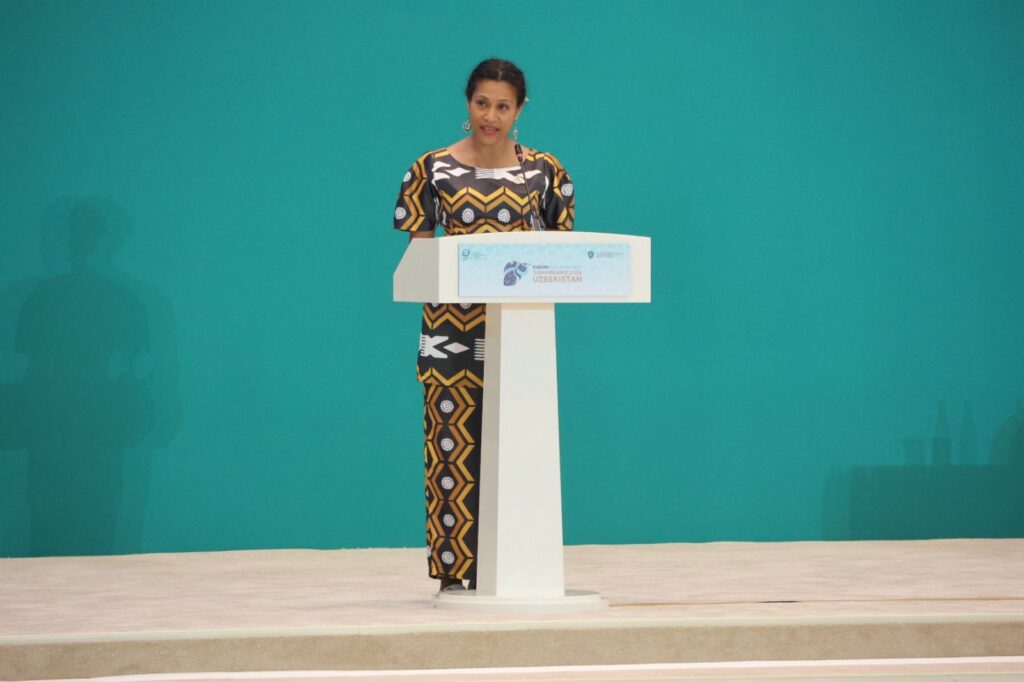
I’m in Samarkand, Uzbekistan this week wearing three hats: as Fiji’s Minister for Environment and Climate Change, Chair of Pacific Small Island Developing States (PSIDS), and Political Champion for Climate Finance.
My job is to make sure Fiji and the Pacific are in the room when decisions are made about climate funding. If we don’t turn up, we won’t be heard. If we’re not heard, funding decisions will be made without understanding the realities our communities face.
Every week, communities come to us asking for help: a seawall to protect homes from rising seas, dredging of rivers to reduce flooding, support for farmers whose crops are being destroyed by floodwaters, solar power for fish cold-storage facilities, electricity for remote villages not connected to the grid, and bridges so children and families can safely cross rivers that regularly flood during heavy rain.
Communities are also asking for better waste management solutions—waste collection services for villages, informal and squatter settlements, recycling facilities, plastic waste reduction projects, composting initiatives, and cleaner rivers, coastlines and public spaces. These are not luxuries. They are essential investments in public health, livelihoods and environmental protection.
All of these needs require funding.
That is why the Global Environment Facility (GEF) Assembly matters. It brings together 186 countries to decide how billions of dollars in environmental and climate finance will be invested over the next four years.
I’m here to advocate for simpler and faster access to climate finance, more grant-based support for vulnerable countries, and funding that delivers practical solutions on the ground for communities.
Last week we were helping communities write climate finance proposals. This week we are helping shape the global rules that determine where that funding goes. Presence matters. If you don’t turn up, you won’t be heard. If you’re not heard, you won’t influence the decisions that affect your people.
This is why being here matters. It is about turning the needs of our communities into investments that protect homes, strengthen livelihoods, improve waste management, safeguard our environment, build resilience and secure a better future for Fiji and the Pacific.